


Used Concrete Pumps
Himalaya Technology Co., Ltd :Your Professional Used Concrete Pumps Manufacturer!
Himalaya Technology Co., Ltd is a modern comprehensive group company, located in Changsha city of China, and we focus on the business of construction machinery, industrial machinery and so on; the company is co-founded by talented & experienced entrepreneurs from these fields.
Professional Team
Himalaya Technology has a team of high efficiency in sourcing management, production management, quality control, delivery fulfillment. In each segment, our staff members can provide a high level of product & services to meet customer's demand for high quality, reliability, and safety.
Premium Quality
We always focusing on great importance on quality from the beginning till the end. Although we provide wide range of products to different customers. Our product portfolio is always concentrating on supplying European and US standards merchandise.
One-Stop Solution
We manage and optimize the supply chain for each industrial segment to supply standardized and customized products and one-stop solution to meet your unique needs. Whether you want to purchase Concrete Pump Truck or Concrete Boom Truck, just email your requirements and we can customize the product for you.
Leading Service
At Himalaya Technology, we provide exceptional pre-sales, in-sales, and after-sales services. Our pre-sale services include detailed product demonstrations and consultancy to help you make the right choice. During the sale, we ensure fast and secure delivery of your orders. After the sale, we offer free training sessions and a dedicated customer service team ready to assist with any issues.


HIMALAYA is a professional supplier of used concrete pumps(used concrete pump trucks,second hand concrete pump trucks,used concrete boom pumps) in China, We supply all brands of used concrete pumps,such as SANY,Putzmeister,ZOOMLION,Schwing,products wtih emission standard from Euro 3 to Euro 6, height from 37m to 75m, with good condition,the products are ready for sales,Welcome to get price and quotation from us or check the products condition on site.
A few companies write false information about the used equipment on the website to increase the attractiveness, for example: production year, mileage, working hours, decorating the equipment condition.
Equipment is a complex machine, there are many technologies of mechanics, hydraulics and electronics. If you buy low-quality used equipment, although the price was low, you will spend more money and time for repairs. Then it's too late to regret!
Honesty is the LOWEST requirement of our company and our people.
What are Used Concrete Pumps?
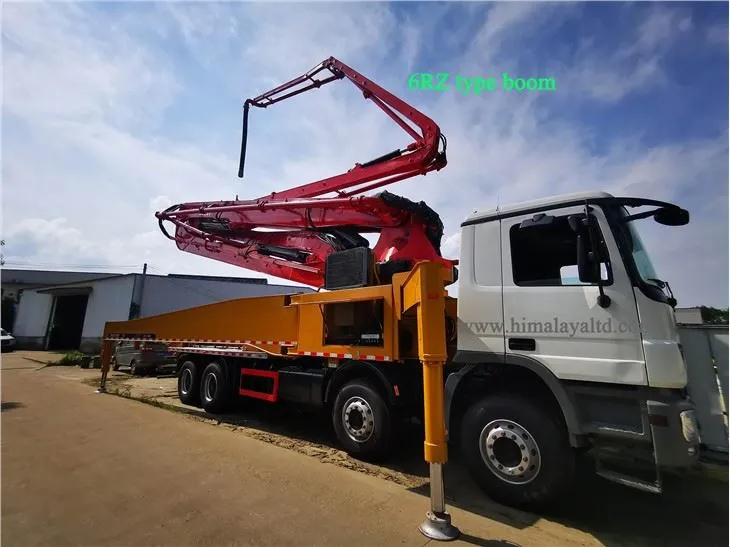
Concrete pumps are specialized machines designed to transport liquid concrete from the mixer truck to the desired location at the construction site. They consist of a pumping mechanism mounted on either a trailer or a truck, equipped with a robotic arm or boom for precise placement of concrete. These pumps play a vital role in projects requiring large volumes of concrete or those with challenging access points. A used concrete pump refers to a concrete pumping machine that has been previously owned and used by another party before being offered for sale in the secondary market.
Benefits of Used Concrete Pumps
Increased Efficiency
Concrete pumps drastically improve the speed of concrete placement compared to traditional methods like wheelbarrows or cranes. They can deliver a large volume of concrete in a short period, reducing labor and overall project duration.
Cost Savings
Investing in a used concrete pump can offer substantial cost savings compared to purchasing a new one. Used equipment, if properly maintained, can perform effectively at a fraction of the cost of new machinery, allowing businesses to allocate their budget more efficiently.
Precision in Placement
Concrete pumps enable precise placement of concrete, even in hard-to-reach areas or complex structures. This accuracy ensures uniformity in concrete distribution, minimizing waste and enhancing the overall quality of the construction project.
Accessibility
Concrete pumps can reach areas that might otherwise be challenging to access, such as narrow alleyways, confined spaces, and high elevations. This accessibility enhances the flexibility and adaptability of construction projects.
Improved Concrete Quality
The consistent flow and controlled delivery of concrete through pumps help maintain its integrity, preventing segregation and ensuring a more uniform mixture.
Reduced Site Footprint
The compact nature of concrete pumps, especially line pumps, reduces the space required for concrete delivery and placement equipment. This is particularly beneficial in urban environments where space is limited.
Applications of Used Concrete Pumps
Concrete pumps play a crucial role in a wide range of construction projects due to their efficiency, accuracy, and versatility. Their ability to transport and place concrete with precision makes them essential tools for various applications. Here are some of the key applications of concrete pumps:


High-Rise Buildings
Concrete pumps are extensively used in the construction of high-rise buildings. Their ability to reach great heights with boom systems ensures that concrete can be efficiently delivered to upper floors, reducing the need for manual labor-intensive methods.
Commercial and Industrial Structures
Concrete pumps are utilized in the construction of commercial complexes, industrial facilities, warehouses, and factories. They enable the rapid and precise placement of concrete for large floor areas and specialized structures.
Bridge Construction
Building bridges often require precise concrete placement in challenging locations, such as over water or steep terrain. Concrete pumps, especially those equipped with booms, provide the necessary flexibility and accuracy for constructing bridge decks, piers, and abutments.
Infrastructure Development
Concrete pumps are essential for infrastructure projects such as roads, highways, tunnels, and airports. They facilitate the efficient pouring of concrete for pavements, curbs, barriers, and other components.
Residential Construction
In residential construction, concrete pumps are used for foundations, basement floors, driveways, and other concrete elements. Their precision and speed help expedite the construction process and ensure quality.
Tilt-Up Construction
Tilt-up construction involves casting concrete wall panels on-site and then tilting them into place. Concrete pumps are used to fill the forms quickly and accurately, enabling efficient assembly of tilt-up panels.
Shotcrete and Sprayed Concrete
Concrete pumps are often employed in shotcrete applications, where concrete is pneumatically projected onto surfaces. This method is commonly used for creating structural walls, and swimming pools, and repairing existing structures.
Decorative and Architectural Concrete
Concrete pumps are used to deliver and place decorative concrete mixes for architectural features such as stamped concrete, textured finishes, and artistic designs.
Types of Used Concrete Pumps
Based on the pumping pressure, ease of working and developing technologies different concrete pumps have been developed. The main classification of concrete pumps are: Line Concrete Pumps, Boom Concrete Pumps and Specialty Pumps.
Boom Concrete Pumps
Boom concrete pumps stay at one particular position for the entire time of concrete pouring on a construction project. Hence these are stationary concrete pumps. They have a larger dimension which is placed on the ground. These have crane or boom arm attached to it in different lengths. Boom concrete pumps allow the pipeline to reach along, upwards and below. Hence tight spots can be cast by these pumps. Obstacles during the concrete casting path can be easily overcome by such pumps.
Line Concrete Pumps
Line concrete pumps are compact units that are mainly used for small construction projects. The arrangement has a line pump attached to the back of the truck or the trailer. Hence the arrangement is also called as trailer mounted concrete pump or truck mounted concrete pump. Line pumps are a cost-effective solution for smaller projects, as they require less labor and can be operated by a single person. They are commonly used for residential construction, such as driveways, patios, and sidewalks.
Specialty Pumps
While boom pumps and line pumps are commonly used in construction projects, there are also specialty pumps available for specific applications. These specialized concrete pumping equipment cater to niche requirements and are used in specialized construction projects. For example, there are specialized pumps for shotcreting, which is a technique used in slope stabilization, tunneling, or repair work. Shotcrete pumps provide high-pressure jets of concrete that are sprayed onto surfaces, ensuring excellent adherence and fast application. This method is particularly useful in creating protective linings for tunnels or stabilizing slopes in areas prone to landslides.
Components of Used Concrete Pumps
A concrete pump has many components, and each is vital in pumping concrete effectively. Consider the following essential parts of concrete pumps.
The primary pump circuit is one of a concrete boom pump’s most crucial parts. This circuit controls the parallel hydraulic drive cylinders and features the following components.
Piston pump: The main hydraulic power pump gets its power from a variable displacement axial piston pump complete with a swashplate design. Adjusting the swashplate angle changes the stroke length of the pistons, and this process changes the concrete displacement. The more flow, the larger the swashplate angle becomes. Operators can adjust the swashplate angle using the load sense feature and the volume control.
Motor: An engine or electric motor powers the main hydraulic pump. When the engine operates like usual, the pump switches off, minimizing the pressure on the pump and providing enough power to keep the pump lubricated.
Valve manifold: A valve on the main circuit controls flow, the relief valve, the check valve and the pilot-operated directional valve.
Throttle control: To energize the pump circuit, the operator sets the speed to maximum RPM using the throttle control.
Cycling circuit: Once the pump switches on, it immediately triggers the cycling circuit. This circuit generates an electrical signal and activates the directional valves.
Material cylinders: The two parallel cylinders alternately pump the concrete. Proximity sensors trigger the material pumping action, sending the signal from the sensors to the logic controller.
Relief valve: This valve protects the primary pump circuit from extreme pressure. When the system pressure reaches the maximum allowed, the relief valve opens to let oil return to the tank.
This circuit controls the function for shifting the S-tube from one cylinder to the other during pumping. As there’s a single outlet for pumping material, there must be a method to transfer concrete from the cylinder to the outlet and then onto the delivery line. The hopper has an S-tube to ensure task completion. There’s one S-tube for two cylinders, so it must be easy to shift from one cylinder to another. We can explain this circuit by considering each of the following components.
Tandem pump: To meet pressure and flow requirements, a tandem pump installed in a single section of the shift circuit connects to the main hydraulic pump, which drives it.
Manifold block: Just like the main hydraulic circuit, there are manifold blocks in the shift circuit.
The agitator’s hydraulic function is part of the auxiliary unit. The circuit controls the operation of the agitator and other additional equipment.The agitator rotates to mix the concrete in the hopper and feed the cylinders. The tandem pump on the main circuit serves the auxiliary circuit. A solenoid cartridge or dump valve is a safety mechanism to prevent flow to the auxiliary circuit when the operator activates the emergency stop circuit. One of the most significant functions of the auxiliary circuit is to assist in pumping concrete high in the air and over long distances. The main components of this system include the following.
Elbow with wear-detecting holes: These holes in the concrete pump elbows consist of quench casting material. They smooth the ready-mixed concrete flow and increase safety and durability.
Outrigger: This component hangs at an oblique angle and widens the overhanging area for more significant stable movement.
U-shaped bottom of the hopper: This part facilitates the initial movement of the liquid concrete from the hopper into the intake port. Cleaning is more accessible due to the efficient flow of the ready-mixed concrete, as it reduces the remaining volume.
Power-operated vacuum pump: This battery-powered vacuum pump minimizes pulsation and discontinuity in concrete flow. This component creates a more homogeneous mixture.
The spraying arm positions the concrete flow at the correct location. Telescopic elevation platforms and scaffolding are unnecessary, as the component can spray for distances up to 56 feet. The spraying head mixes concrete, elevators and air. The nozzle dimensions and overall design are vital for ensuring minimal rebound and correctly incorporating the concrete.
The air compressor gives the concrete the kinetic energy to spray and compact. A specific velocity is necessary for shotcrete to impact the site’s surface, achieved with the compressor’s airflow and the correct nozzle diameter.
The accelerator meets the requirement for early strength development by speeding up the hardening of the concrete. The dosage depends on the concrete flow at all times. A synchronized dosing device, combined with the concrete pump, performs this function.
The motorized chassis transports the concrete pump to the desired location. The chassis design is crucial, as it needs to be able to turn in relatively small spaces and operate on uneven terrain.
The control panel allows for ease of operation and confirms the condition of the ready-mixed concrete inside the hopper. Operators can control the pumping speed based on the operation’s needs. The digital display indicates when to perform maintenance checks or replacements. Operators can use a remote control to manage the spraying process on site. Remote controls can be wireless or work via a cable connection and organize all the concrete components from one convenient location.
Factors to Consider When Buying Used Concrete Pumps
Condition and Age of the Equipment
When purchasing a used concrete pump, the condition and age of the equipment are paramount. Inspect the pump thoroughly for signs of wear and tear, corrosion, or structural damage, as these factors can affect its performance and longevity.
Maintenance History
Obtain detailed information about the maintenance history of the used concrete pump. Regular servicing and proper upkeep are indicators of a well-maintained machine that is likely to perform reliably in the future.
Brand Reputation
Consider the reputation of the brand when evaluating used concrete pumps. Established manufacturers known for producing high-quality and durable equipment are more likely to offer reliable used pumps that meet industry standards.
Factors Affecting Pipeline Pressure of Used Concrete Pumps
In order to optimize the concrete pumping operation, the most efficient configuration of the system must be determined. The correct line pressure must be determined to move concrete at a specified rate of flow through a pipeline of a particular length and diameter. The major factors affecting pipeline pressure are:
Line Diameter
Larger-diameter pipelines require less pumping pressure than smaller-diameter pipes. However, there are disadvantages to using the larger conduits, such as increased blocking, bracing and labor needed. Regarding the concrete mix in relation to line diameter, the maximum size of aggregate should be no larger than one-third of the diameter of the line, according to ACI standards.
Line Length
Concrete being pumped through a line experiences friction with the internal wall of the pipeline. The longer the line, the more friction encountered. For longer pumping distances, the use of smooth-walled steel pipe can lower the resistance. The length of hose used at the end of the pipeline adds to the overall line length as well.
Horizontal Distance and Vertical Rise
The farther or higher the concrete needs to go, the more pressure it will take to get it there. If there is a long horizontal distance to cover, one option is to use two lines and two pumps, with the first pump feeding into the hopper of the second pump. This method may be more efficient than a single, long-distance line.
Reducing Sections
Resistance will also increase if there is a reduction in pipe diameter along the path the concrete travels. Whenever possible, the same diameter line should be used. However, if reducers are needed, longer reducers will cause less resistance. Less force is needed to push concrete through an eight-foot reducer than through a four-foot reducer.
Safety Measures When Using Used Concrete Pumps
Operating concrete pumps involves inherent risks, and it is crucial to prioritize safety to protect the operators and the surrounding environment. Here are some essential safety measures to consider:
Operator Training
Proper training and certification for concrete pump operators are vital. Operators should receive comprehensive instructions on operating the specific type of instructions be using, including safety protocols, equipment inspection, and maintenance.
Regular Maintenance and Inspection
Regular maintenance and inspection of the concrete pump are necessary to ensure its safe and efficient operation. Regularly check the pump for any signs of wear and tear, leaks, or malfunctioning parts. Adequate lubrication and cleaning of the pump are also vital.
Proper Use of Safety Equipment
Operators should always wear the necessary personal protective equipment (PPE), such as hard hats, high-visibility vests, gloves, and safety boots. Additionally, safety barriers and warning signs should be used to mark the working area and protect bystanders.